
Empowering Lives Through Service
Service dogs that restore confidence, safety, and freedom — trained to the highest professional standards.
The Northwest Elite Service Dog Program
At Northwest Elite Working Dogs, a small, family-owned business, we train service dogs for the individual needs of their future handlers, including children with autism, adults, veterans, and first responders. We welcome inquiries from people who need a service dog; acceptance depends on an individual application review and program fit.
Tasks are discussed during the application process and selected to help with the individual’s disability-related needs. We do not promise a fixed number of tasks for every dog.
We follow ADI’s published training and ethical standards as guidance for our own program. Northwest Elite is not a member of or accredited by Assistance Dogs International (ADI). ADI currently limits membership to nonprofit or charitable organizations. Our internal evaluations do not constitute ADI accreditation or a legally required service-dog certification.
Who We Serve
Our service dogs support clients across a range of needs, including:
PTSD & Trauma Response — for veterans, first responders, and civilians.
Autism Support — calming, safety, and redirection tasks for children and adults.
Mobility & Stability — retrieving items, bracing, and balance assistance.
Anxiety & Panic Disorder — deep-pressure therapy, grounding, and crowd navigation.
- Medical Alerting – Seizure, Diabetes and other medical conditions.
Each client receives a personalized plan so training matches your lifestyle, environment, and priorities.
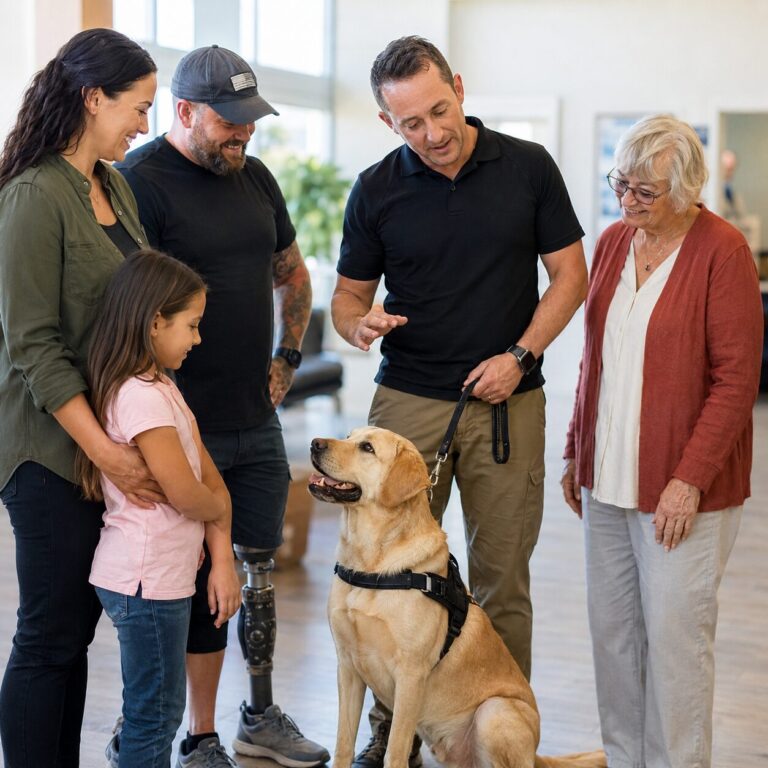
Why We Train Every Dog From Start to Finish
We’re sometimes asked whether we support owner-trained service dogs — and we want to answer that honestly, because you deserve a straight answer rather than marketing language.
The short answer is: we don’t, and here’s why.
A service dog isn’t a well-behaved pet with a vest. Our program typically involves approximately 600–800 hours of training before placement. Puppy training runs from approximately 8–20 weeks of age; Phase 1 starts at about 20 weeks old. Phases 1–3 each last approximately 16–20 weeks, with about 200 training hours in Phase 1 and about 200–300 hours each in Phases 2 and 3. Task work is integrated into Phase 3 and continues into early Phase 4 before going home. These are estimates, not fixed requirements: each dog progresses at its own pace. Additional training may be needed based on the number and complexity of the owner’s required tasks. Teaching a dog to alert to a blood sugar drop, interrupt a PTSD flashback, or brace for a person with a mobility condition isn’t something that can be learned from YouTube videos, a weekend workshop or a 6 week lesson program. It requires years of experience in behavior modification, task shaping, and reading a dog’s drive, body language and temperament under pressure.
We’ve seen what happens when that foundation isn’t there. A dog that performs beautifully at home can fall apart in a hospital, a crowded airport, a business office or a school hallway. That moment of failure doesn’t just embarrass the handler — it can put them in danger, damage the reputation of service dogs everywhere, and leave a family without the support they were counting on.
We don’t say this to be gatekeepers. We say it because we genuinely care about your outcome. When your dog graduates from our program, you are getting an animal that has been tested, evaluated, and proven — not a hopeful work in progress.
Your job during this process is to trust us with the training and show up ready for Phase 4 team training before going home, where you’ll learn to work with your dog as a partner. That collaboration is built into our program by design. Phase 4 also includes follow-up support after you and your dog go home, with no fixed hour allotment.
How Our Training Works
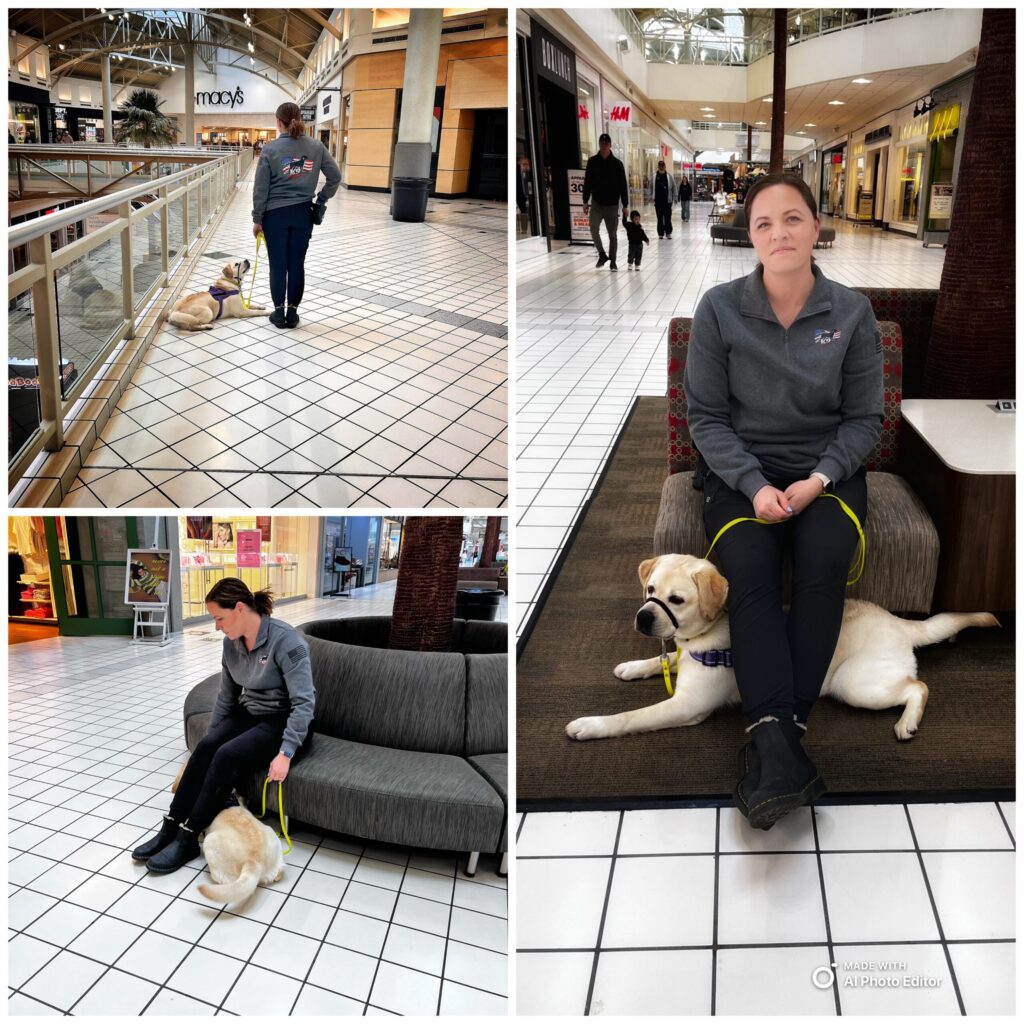
Our process is methodical, humane, and results-driven.
Positive Reinforcement: Science-based methods create confidence, not fear.
Real-World Exposure: Dogs are trained in homes, parks, stores, offices, and public spaces.
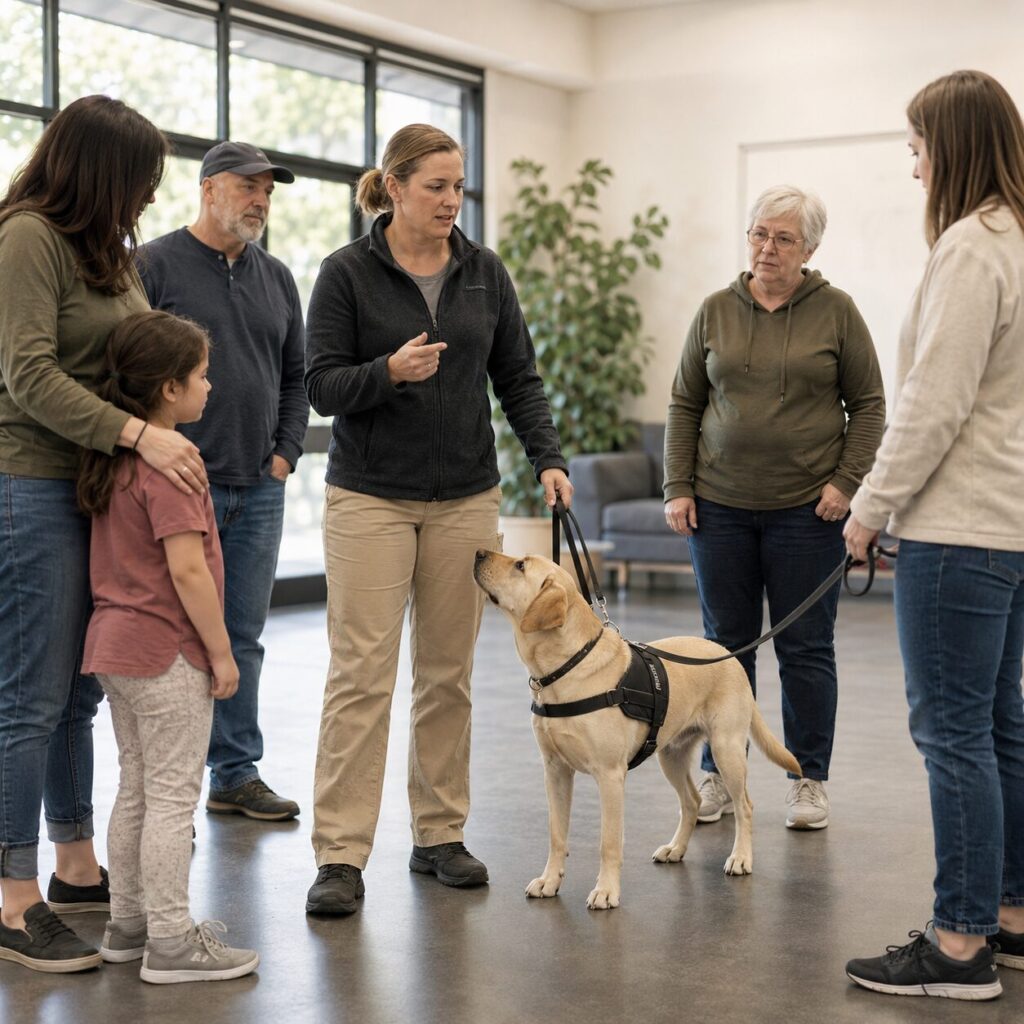
Handler Training: You’ll participate in guided sessions that build teamwork and trust.
Progress Milestones: Structured benchmarks confirm readiness before advancing. Phases 1–3 each last approximately 16–20 weeks, but each dog progresses at its own pace. Timing also depends on required tasks; advancement is based on readiness rather than a fixed deadline.
“Precision training built on empathy — because reliability and heart go hand-in-hand.”
The Placement Process
- Initial Consultation – We discuss your goals and qualifications.
- Formal Application – Full review of your lifestyle and support needs.
- Dog Selection – Carefully chosen and temperament-tested candidates.
- Puppy Training – Approximately 8–20 weeks of age.
- Training Phases 1–3 – Phase 1 starts at about 20 weeks old. Each phase lasts approximately 16–20 weeks, with about 200 training hours in Phase 1 and about 200–300 hours each in Phases 2 and 3.
- Phase 4: Going Home and Follow-Up Support – Task work is integrated into Phase 3 and continues into early Phase 4 before going home. Phase 4 also includes team training with the new owner, followed by ongoing lifetime guidance and refreshers after going home, with no fixed hour allotment.
The average wait to receive a service dog is 18–24 months. Dogs typically go home at 18–24 months of age. Wait time and the dog’s age are separate estimates. Dogs may finish Phase 3 at roughly 16–19 months of age, with task work and team preparation continuing into early Phase 4 before going home.
Each dog progresses at its own pace, and the number and complexity of required tasks affect timing. These are estimates rather than fixed deadlines. We discuss candidate selection, matching, and your individual timeline during consultation.
Lifetime Partnership Support
Your relationship with Northwest Elite doesn’t end at graduation.
We provide refresher training, annual check-ins, and emergency support for the life of your partnership — ensuring long-term consistency and reliability.
Real Stories of Transformation
“Our daughter’s autism support dog has changed everything about our family dynamic — calm mornings, confident outings, and genuine joy.” — John, Spokane
Available Nationwide
Our service dogs are available across the United States, with in-person training.
From Spokane to Dallas, we can help families, veterans and first responders restore independence and confidence.
Begin Your Journey With a Trusted Partner.
Service dog programs designed for independence and lasting confidence.
Frequently Asked Questions
Clear answers about timelines, eligibility, tasks, access rights, and placement.
How long does service dog training take?
The average wait to receive a service dog is 18–24 months. Dogs typically go home at 18–24 months of age. Wait time and the dog’s age are separate estimates.
Puppy training runs from approximately 8–20 weeks of age. Phase 1 begins at about 20 weeks old, and Phases 1–3 each last approximately 16–20 weeks. Dogs may finish Phase 3 at roughly 16–19 months of age; task work is integrated into Phase 3 and continues into early Phase 4 before going home, along with team training for the new owner.
These are estimates, not fixed deadlines: each dog progresses at its own pace, and the number and complexity of required tasks may extend training. We discuss candidate selection, matching, and your individual timeline during consultation.
Readiness is assessed before advancing. Our testing standards include AKC S.T.A.R. Puppy, Canine Good Citizen, Urban Canine, and Community Canine.
Who qualifies for a service dog?
Applicants should have a disability-related need that can be helped by individually trained tasks, the ability to participate in handler training with appropriate family or caregiver support, and a suitable home environment for the dog. We welcome inquiries from children and adults, including children with autism. We discuss the individual’s needs, tasks, and program fit during the application process.
Before acceptance into Northwest Elite’s program, we require a doctor’s note or prescription from a licensed doctor. This is our program’s acceptance requirement, not an ADA requirement for entering public places with a service dog.
The ADA does not require service-dog certification or registration. A service dog must be individually trained to do work or perform tasks related to a person’s disability. Public-access rules also require the dog to be housebroken and under control. See the official ADA service-animal guidance.
What tasks can your service dogs be trained to perform?
Examples include PTSD/Anxiety (deep-pressure therapy, panic interruption, exit/crowd navigation),
Autism (redirection, compression, safety support), and Mobility</strong> (retrieve, brace on cue, item carry, button press). Medical alert (seizure / diabetes).
Task sets are customized to your clinical priorities and daily life.
Do service dogs have public access rights?
Under the ADA, a service dog is individually trained to do work or perform tasks related to a person’s disability. Service dogs generally may accompany their handlers in public areas of businesses and state or local government facilities. The dog must be housebroken and under control; limited exceptions apply.
The ADA does not require service-dog certification, registration, or a special ID. When the need is not apparent, staff may ask whether the dog is required because of a disability and what work or task it has been trained to perform. They may not require medical documentation or a task demonstration.
Northwest Elite’s doctor’s-note requirement applies to acceptance into our program, not public access. See the U.S. Department of Justice ADA guidance.
What is the placement process and what support do you provide?
Our pathway includes consultation, formal application, dog selection, puppy training at approximately 8–20 weeks of age, and Phases 1–3 at approximately 16–20 weeks each. Phase 1 begins at about 20 weeks old.
Task work is integrated into Phase 3 and continues into early Phase 4 before going home. Phase 4 includes team training with the new owner, followed by lifetime support, ongoing check-ins, refresher training, and re-evaluation options.
Timing is individualized, not a fixed wait or placement promise. Each dog progresses at its own pace, and required tasks may extend training. Phase 4 has no fixed hour allotment.
Do you support owner-trained service dogs?
We do not currently offer an owner-trained service-dog program. Northwest Elite raises and trains dogs within our own program and prepares each dog for its future handler. This describes our current offering, not a legal restriction on owner-trained service dogs.
The ADA permits people with disabilities to train their own service dogs and does not require professional training, certification, or ADI accreditation. Our program’s training hours, evaluations, and acceptance requirements are separate from those legal requirements.
Our training estimates are about 200 hours in Phase 1 and about 200–300 hours each in Phases 2 and 3. Puppy training takes place at approximately 8–20 weeks of age; Phase 1 starts at about 20 weeks old, and Phases 1–3 each last approximately 16–20 weeks. Task work is integrated into Phase 3 and early Phase 4 before going home. Each dog progresses at its own pace, and required tasks may extend training.
You will participate in Phase 4 team training before going home, followed by support afterward, with no fixed hour allotment.
Telephone No.5094819065